
Marketing automation in Morocco in 2026: if you are an SME, an e-commerce business, or a marketing team looking to save time, better qualify your leads, and increase your sales without multiplying manual tasks, this article is for you.
No theory here: you will find a step-by-step method, concrete scenarios (abandoned cart, B2B nurturing, post-purchase follow-up), a tool comparison adapted to Moroccan budgets, and an operational checklist to launch your first workflows in 30 days.
By reading this guide, you will learn:
Let’s get started!
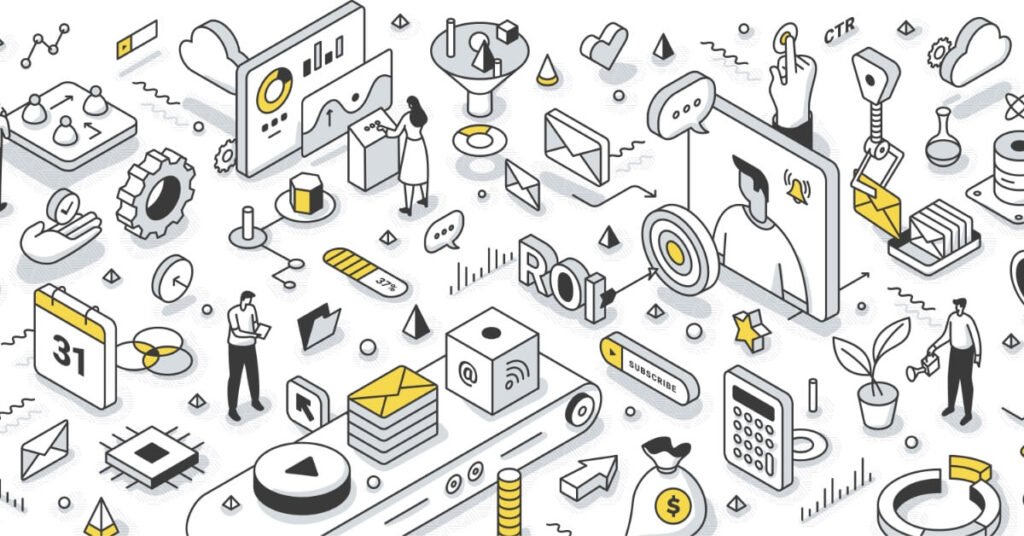
In 2026, customer behavior in Morocco has changed dramatically: they compare options, check multiple sources, leave abandoned carts, ask questions on WhatsApp, and return several days later.
Without a system capable of automatically tracking these interactions and responding at the right time, a business loses sales—often without even realizing it.
This is exactly where marketing automation becomes essential: it allows you to personalize every step of the customer journey automatically, without adding to your workload.
A company can manage more leads, follow up more efficiently, and increase conversion rates, even with a small team.
Contrary to what many imagine, marketing automation is not reserved for large corporations.
In Morocco, SMEs, e-commerce stores, and service providers achieve fast results because:
In most businesses, the first automations generate measurable impact within a few weeks: more qualified leads, lower acquisition costs, and, most importantly, a higher percentage of prospects progressing through the sales funnel.
Over the past two years, marketing automation has evolved rapidly. In 2026, three major trends are shaping Moroccan businesses:
The result: marketing automation is no longer a luxury; it’s a strategic lever for any company looking to increase online sales, streamline operations, and structure lead acquisition.
In the next section, we’ll explore concrete use cases—e-commerce, B2B, services, and retail—that Moroccan businesses can deploy immediately for fast results.
Marketing automation is not an abstract idea or a technology reserved for large companies.
In 2026, Moroccan SMEs, e-commerce stores, service providers, and even physical retail locations use automation to recover lost sales, support their customers, and accelerate decision-making.
Here are the scenarios that work best in Morocco—concrete workflows you can implement immediately, even with a simple tool.
For Moroccan online stores, automation directly impacts revenue.
Most visitors don’t buy on their first visit, but with the right workflows, you can bring them back at the right moment.
In Moroccan B2B companies, the real problem is not a lack of leads…
but a lack of structured follow-up. Leads arrive but are not nurtured, supported, or followed up.
Marketing automation solves this problem.
Even physical stores in Morocco can benefit from automation.
Using SMS, WhatsApp Business API, or simple forms, you can create a lasting connection with every customer.
All these use cases share one thing in common: they prevent missed opportunities, increase customer value, and streamline the experience without adding to your team’s workload.
In the next section, we’ll look at what makes up a complete automation system: CRM, tags, workflows, integrations, and tracking—a solid foundation essential for effective workflows.
A good marketing automation system relies on several elements working together to turn a simple visitor into a loyal customer. Here are the essential components:
This is the heart of your system. A CRM gathers all information about your leads and customers: contact details, interactions, purchase history, preferences… Without a clean and well-structured database, no automation can be effective.
These are your lead capture tools. They collect the necessary information to send personalized content later. An optimized landing page can significantly boost conversions, especially in competitive markets like Morocco.
These are the “automated paths” you define: emails sent after registration, abandoned cart follow-ups, welcome sequences, lead qualification… This is where the magic happens.
Emails, WhatsApp messages, notifications, SMS campaigns… Automated content must be personal, relevant, and human. Good automation never sends generic messages.
This assigns a score to prospects based on their actions (clicks, pages visited, downloads…). It helps your team know who is ready to buy and when to intervene.
You can’t improve what you don’t measure. Analytics tools show what works, what needs optimization, and how to improve conversions step by step.
The marketing automation tools market has exploded in recent years. For a Moroccan business, the real challenge is not finding a solution, but choosing one that truly fits your digital maturity, budget, and goals. Here’s an honest and clear analysis to help you make the right choice.
| Tool | Use Case | Advantages | Estimated Price |
|---|---|---|---|
| Brevo (ex-Sendinblue) | SMEs, e-commerce, simple email marketing, basic automations | Easy to use, French support, excellent value for money | €0–50/month |
| MailerLite | Creators, SMEs, simple automations + landing pages | Intuitive interface, good email editor, very affordable | €0–25/month |
| HubSpot Starter | Growing SMEs, centralized CRM, lead nurturing | Powerful CRM, advanced automations, all-in-one tool | €20–70/month |
| ActiveCampaign | E-commerce, fast-growing businesses, advanced segmentation | Very powerful workflows, scoring, e-commerce integrations | €29–149/month |
| Salesforce Marketing Cloud | Large enterprises, multi-channel strategies | Ultra-complete, powerful, suited for mature marketing teams | Quote-based (expensive) |
| Marketo | Enterprise, B2B, advanced nurturing | Robust tool, ideal for long sales cycles | Quote-based |
| Mautic (open source) | Tech-savvy teams, companies wanting a fully customizable solution | Open source, flexible, no per-user cost | Free (requires hosting + maintenance) |
These tools are perfect for Moroccan micro and small businesses wanting to automate emails without complexity. Brevo, very popular in Morocco, is ideal thanks to its French support and pricing based on the number of emails sent rather than database size. MailerLite focuses on simplicity and integrated landing pages, making it great for small businesses or freelancers.
When your marketing becomes more mature, you need more advanced automations: scoring, nurturing, e-commerce integrations, advanced segmentation… HubSpot Starter is often the best entry point: complete CRM, modern interface, reasonable pricing. ActiveCampaign is more technical but extremely powerful for online stores thanks to its advanced workflows.
These solutions are suitable only for large organizations: banks, insurance, telecom operators, national groups… They require a significant budget, a mature marketing team, and complex multi-channel orchestration. For most Moroccan businesses, this level is unnecessary, but essential for large organizations.
Mautic is an excellent option for technical teams or companies wanting full control over their data. The tool is free but requires a server, regular updates, and a capable team. Ideal if you want to avoid monthly subscriptions and build a fully customized system.
Marketing automation is not just about tools: it’s a methodology. To successfully deploy it in a Moroccan SME or e-commerce business, you need a structured approach. Here’s a clear, realistic, and immediately actionable plan.
Before automating, make sure the foundations are solid. Here’s the essential checklist:
This step is often overlooked but determines the success of your entire strategy.
Effective automation relies on a precise understanding of your customers. It’s essential to define:
Then map the complete journey:
Each stage should correspond to a message, an automation, and a specific goal.
To start quickly without complexity, deploy three high-impact automations first:
These three automations often generate +15–40% additional conversions within a few weeks.
Automation is never perfect on day one. It must be tested, measured, and optimized:
The goal: turn an automated system into a coherent engine connecting marketing, acquisition, and sales.
To know if your strategy works, track the metrics that really matter:
Measuring ROI allows you to improve each automation and transform an “automatic” system into a true growth engine.
To illustrate the concrete impact of marketing automation in Morocco, here’s an example based on a typical client case (fictional but entirely realistic). It’s an online clothing store in Casablanca, processing around 450 orders per month.
The problem is simple and common: a cart abandonment rate over 78%. Despite good traffic from Instagram and Google Ads, a large portion of visitors left the site before completing a purchase.
After a quick audit, three automations were implemented:
In parallel, the store set up a simple scoring system to identify the hottest leads (repeat visits + cart additions + WhatsApp clicks).
Results after 60 days:
This type of result is typical for Moroccan e-commerce stores once automations are properly configured and messages remain human and personalized.
Marketing automation is a powerful lever, but if used incorrectly, it can quickly become counterproductive. Here are the most frequent mistakes we see in Moroccan businesses, and how to avoid them.
The first mistake is rushing into tools without a clear plan. Some managers set up workflows “out of curiosity” or “because the tool allows it,” but without specific objectives or KPIs. Result: emails sent indiscriminately, impersonal communication, and loss of prospect trust.
Solution: start with an audit, define your personas and journeys, then prioritize 1–3 automations with a concrete goal (e.g., recovering abandoned carts).
Sending the same message to all prospects is a classic mistake. Each persona has different needs, behaviors, and objections. Generic communication reduces the effectiveness of your automations.
Solution: segment contacts by client type, purchase history, website behavior, lead source. This ensures relevant and personalized messages.
Successful automation is not just “programming emails.” Content must be clear, engaging, and adapted to the Moroccan market: French, Arabic, or bilingual depending on your audience. An impersonal or overly promotional email can harm your image.
Solution: use a human tone, test your messages, and personalize whenever possible (name, product viewed, city…).
Some companies set up a workflow and forget it. They don’t track open rates, clicks, or conversion rates. Without measurement, it’s impossible to know what works.
Solution: define KPIs (CPL, CVR, ARPU, LTV) and regularly analyze results to improve each automation.
If marketing and sales don’t communicate, opportunities can be missed. Example: a hot lead might remain inactive if no one calls on time, or a prospect could be contacted twice by the same team, creating confusion.
Solution: define a clear SLA (Service Level Agreement): who follows up on which type of lead, within what timeframe, and how scoring is updated.
Avoiding these pitfalls allows you to maximize your marketing automation, improve conversion, and provide a consistent, enjoyable customer experience.
Marketing automation is no longer optional for Moroccan businesses: it’s a strategic lever that allows you to save time, increase your sales, and deliver a consistent customer experience.
By following this step-by-step guide, you can:
As seen in our case study, even a Moroccan online store can reduce cart abandonment by 30% and increase sales simply by properly setting up a few automations.
The best time to take action is now. Don’t let your prospects slip away or your teams waste time on repetitive tasks.
At AzulWeb, we help Moroccan businesses create or redesign their websites, improve their Google visibility through SEO, develop a consistent visual identity, and provide support and maintenance for their platforms. We also assist in optimizing business processes and CRM through our BPO and Operational Excellence services. If you want to learn how to leverage marketing automation for your leads and customers without going it alone, we can advise you and propose solutions tailored to your business.
Bring your ideas to life with a modern, high-performing website designed around your goals.
At AzulWeb, we support you from the very first idea to the final launch.