
Choosing web hosting in Morocco in 2026 is not as straightforward as it may seem.
Many entrepreneurs and business owners still believe that there are numerous Moroccan hosting providers with servers physically located in Morocco.
In reality, most offers available on the market are provided by resellers who sell foreign hosting solutions (mainly based in France, Spain, or Germany) under a local brand name.
As a result, it becomes difficult to know where your data is actually hosted, and more importantly, to understand the real impact this has on your website’s speed, security, uptime, and overall reliability.
In 2026, these factors are critical not only for user experience, but also for search engine optimization and Google rankings.
In this complete guide, we clarify the current situation of web hosting in Morocco, explain the difference between resellers and real data centers, and most importantly, provide you with a clear and practical method for choosing the right hosting solution for your project.
Whether you are an SME looking for a reliable and affordable solution, an e-commerce business that requires performance and stability, or a startup planning for scalability, this guide will help you avoid costly mistakes.
The goal is simple: help you make an informed decision, without unnecessary technical jargon, and invest in hosting that will truly support the long-term growth of your website in 2026.
If you prefer to access a direct comparative analysis based on recent tests and measured performance, we have published two complete and updated studies for 2026.
These guides include speed tests, customer support analysis, pricing evaluation in Moroccan dirhams, as well as an objective assessment of the strengths and limitations of each hosting provider for the Moroccan market.
If your goal is to save time and quickly identify the solution best suited to your project, you can review these analyses before continuing with this guide.
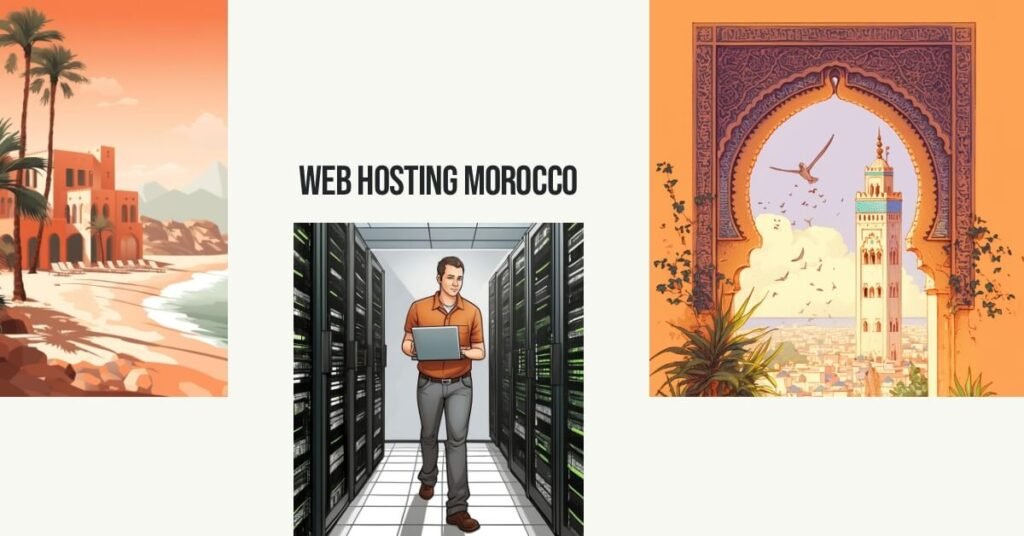
When we talk about web hosting in Morocco, the first question to ask is simple: where is your data actually stored? Most Moroccan companies that advertise “hosting offers” don’t own their own datacenters. They actually operate as resellers, renting servers from major international providers (often in Europe) and reselling them under a local brand.
A reseller has no physical infrastructure or server rooms. They buy resources from a foreign hosting provider and resell them to end clients. The advantage: local support (often in French or Arabic), payment options adapted to Morocco (local bank transfer, sometimes even cash), and a contact person based in the country. The drawback: your data isn’t really hosted in Morocco, but in Europe. The latency (delay between server and user) may be slightly higher, and the quality depends entirely on the original provider.
A local datacenter, on the other hand, owns servers physically located in Morocco. This is the case for some major telecom operators or specialized projects. It ensures minimal latency for Moroccan visitors, better regulatory compliance, and sometimes the possibility of getting a Moroccan IP address. But these services remain more expensive and are often targeted at large enterprises or government bodies.
📌 Key Takeaways
Now that you know where servers are really located, let’s look at how to choose the right hosting plan for your website. Good hosting isn’t just about price — it should guarantee performance, security, and stability. Here are the main criteria to review before pulling out your credit card.
Website speed is crucial: a slow site drives visitors away and hurts your Google ranking. Check:
💡 Tip: Run a speed test with tools like GTmetrix or PageSpeed Insights before purchasing.
A reliable host should guarantee at least 99.9% uptime. That means less than 9 hours of downtime per year. Beware of vague promises — demand a clear SLA (Service Level Agreement).
Incidents happen: hacking, bugs, human error. Check whether the host offers:
A serious hosting provider should include by default:
Often overlooked! Check:
Local support can be a big advantage if you’re not comfortable with technical English.
Some Moroccan companies or government bodies require a local IP address for regulatory or contractual reasons. In that case, only Moroccan datacenters can provide it. For everyone else, European servers + a CDN are sufficient.
Displayed prices can be misleading: many hosts advertise very low first-year promos… then double or triple the price upon renewal. Always check:
📌 Key Takeaways
Not all websites have the same needs. The choice of web hosting in Morocco (or abroad) should depend on the type of project and required resources. Here are some concrete cases to guide you.
A small site with just a few pages to present a business doesn’t need very powerful servers. 👉 A quality shared hosting plan or a small VPS (Virtual Private Server) is more than enough.
An e-commerce site gets more traffic, processes payments, and must be online 24/7. Here, you need something stronger: 👉 A properly configured VPS or a dedicated server for more stability.
If you’re building a platform, SaaS, or app that needs to grow fast, you’ll need scalability. 👉 Go for cloud hosting (AWS, Google Cloud, Azure, OVH Cloud, etc.), which lets you scale resources on demand.
Some projects require a Moroccan IP (for public tenders, institutions, or strict compliance). 👉 In this case, you’ll need a datacenter based in Morocco (Maroc Telecom, N+ONE, etc.), even if the price is higher. This option is mostly suited to large companies and public organizations.
📌 Key Takeaways
| Criteria | Moroccan Resellers | International Providers | Local Datacenters |
|---|---|---|---|
| Server Location | Europe (France, Spain, Germany) | Europe / USA / Worldwide | Morocco (Casablanca, Rabat…) |
| Latency for Moroccan Visitors | Good (≈40–60 ms) | Variable (Europe = fine, USA = slower) | Excellent (<10 ms) |
| Support | Local (FR/AR), often responsive | FR/EN depending on provider, sometimes limited | FR/AR, aimed at enterprises |
| Price | Affordable (depends on origin provider) | Competitive (global competition) | Higher, usually for big accounts |
| Backups & Security | Depends on chosen plan (often basic) | Advanced (backups, DDoS protection, SSL included) | Very advanced (redundancy, compliance, ISO) |
| Target Audience | Local SMEs, showcase sites | SMEs, e-commerce, startups | Enterprises, institutions, government |
Before you confirm your hosting, take two minutes to check these essentials:
To help you decide quickly, here are hosting suggestions for three common project types in Morocco.
Profile: a few pages to present activity, contact, and business hours. Recommendation:
Profile: online store with payments, promotions, product catalog. Recommendation:
Profile: web platform, SaaS, or project with high growth potential. Recommendation:
📌 Key Takeaways
Q1: Should I choose a Moroccan hosting provider if my website targets only Morocco?
A: Not necessarily.
Most “Moroccan hosting providers” are resellers whose servers are located in Europe.
With a well-optimized infrastructure and the use of a CDN, a website hosted in France or Spain can perform just as well for Moroccan visitors.
Q2: Is a server located in Europe too slow for users in Morocco?
A: No.
In 2026, average latency between Morocco and Europe remains low (around 40–60 ms), which is more than sufficient for most showcase websites, blogs, and e-commerce stores.
Using a CDN further improves loading speed.
Q3: What is a hosting reseller and how is it different from a data center?
A: A reseller sells hosting services by renting servers from an international provider and rebranding them.
They do not own physical infrastructure.
A data center, on the other hand, owns and manages its own servers, usually offering more control, transparency, and reliability.
Q4: Do I need a Moroccan IP address?
A: Only in specific cases, such as legal, contractual requirements or public tenders.
For most websites, a European IP combined with a CDN is more than sufficient in 2026.
Q5: What criteria should I check before choosing web hosting in Morocco?
A: Key factors include:
performance, uptime, automated backups, security, quality of technical support, real pricing (no hidden fees), and scalability.
The checklist in this article covers all these points.
Q6: Does hosting affect Google SEO?
A: Yes.
Page speed, server reliability, and security (HTTPS, protection against attacks) are all considered by Google.
High-performance hosting directly contributes to better SEO results.
Q7: Can I easily change hosting providers if I make the wrong choice?
A: Yes, but the process can be time-consuming and technical.
It is highly recommended to choose a host that offers easy or assisted migration, or to work with a professional to avoid downtime.
📌 Bonus tip:
Always include web hosting in your SEO and technical planning from the very beginning.
Strong hosting foundations are essential for building a fast, secure, and reliable website in 2026.
Choosing web hosting in Morocco in 2026 is not just about comparing prices. Behind every offer lie essential factors: performance, security, support, and scalability. The right choice will depend on your project — a small showcase website, an online store, or a large-scale platform don’t have the same requirements.
The key is to stay vigilant, analyze your priorities, and check the technical details before committing. Well-thought-out hosting means a faster, safer, better-ranked website… and above all, satisfied visitors.
At AzulWeb, we support Moroccan businesses in their web projects: Technical needs assessment. Personalized recommendations. Hosting setup and optimization. Continuous support to guarantee your site’s performance.
Bring your ideas to life with a modern, high-performing website designed around your goals.
At AzulWeb, we support you from the very first idea to the final launch.